




 Login
Login45th AIVC - ASHRAE IEQ Conference, 2025: Best paper & best poster awards

Best Paper & poster awards were presented during the closing session of the 45th AIVC - ASHRAE IEQ, held jointly with the 13th TightVent and 11th venticool conferences in Montreal, Canada, on 24–26 September 2025.
Best paper award:
The jury for the best paper award — Pilar Linares Alemparte (The Eduardo Torroja Institute for Construction Science - CSIC, Spain), William P. Bahnfleth (The Pennsylvania State University, USA) and Iain A Macdonald (NRC, Canada) nominated the following contributions:
- Quantifying Health Benefits of Stricter PM Standards: A Comparison of EU and WHO Annual Guidelines — Lisa Corneillie , Klaas De Jonge & Jelle Laverge (Ghent University, Belgium)
- Using Natural Language Processing for Designing Air Distribution in an Indoor Space — Ting Dai (The Hong Kong Polytechnic University, Hong Kong), Qingyan Chen (Harvard University, USA)
- Rhizosphere Bacterial Responses to Gasoline Vapour Pollutants: Changes in BTEX Degradation and Enzymatic Activity — Luowen, Stephen Matheson, Peter Irga & Fraser Torpy (University of Technology Sydney, Australia)
- Case Studies of Deploying ASHRAE Standard 241 in Office Buildings — Mengjia Tang, Jason DeGraw & Yanfei Li (Oak Ridge National Laboratory, Knoxville, TN, USA)
Joe Firrantello (Conference Scientific Committee Chair) presented the best paper award to Mengjia Tang and co-authors Jason DeGraw and Yanfei Li (Oak Ridge National Laboratory, Knoxville, TN, USA) for their paper: “Case Studies of Deploying ASHRAE Standard 241 in Office Buildings”.
Abstract: The COVID-19 pandemic has led to worldwide consensus on the importance of indoor aerosol transmission for disease spread. To better prepare for the next infectious disease outbreak, ASHRAE published Standard 241 “Control of Infectious Aerosols”, which is the first-of-its-kind indoor air quality (IAQ) resilience standard that sets requirements for the equivalent clean air delivered to building occupants to control infectious aerosols. For a wide adoption of this new standard, case studies are needed to provide guidance on applying the standard to real buildings. We demonstrated this standard on two office buildings in a mixed humid climate. The two buildings vary in vintage, usage type (single vs. mixed use), HVAC systems, and ventilation/air cleaning methods. We calculated the equivalent clean airflow rates as currently provided by the buildings, compared them with the requirements in the standard, and proposed interventions to meet the standard. We found that the results are more reasonable by investigating rooms or zones that are grouped by HVAC systems and ventilation/air cleaning methods within a building compared to treating the building as a whole. To comply with the standard during the infection risk management mode (IRMM), reducing occupancy is the first step to try, and then a combination of additional interventions (such as increased filtration and natural ventilation) may be required depending on the building.
Best poster award
The best poster award was determined by Constanza Molina (Pontificia Universidad Católica de Chile, Chile), Marco Simonetti (Politecnico di Torino, Italy) and Lula Timmerman (FPS Public Health, Belgium), and was presented by Arnold Janssens (Conference Scientific Committee Co-Chair) to Alexander Y. Mendell (University of Toronto, Canada) and co-authors Seungjae Lee (University of Toronto, Canada) and Jeffrey A. Siegel (University of Toronto, Canada) for their poster: “Impacts of User Behaviour on Portable Air Cleaner Performance”.
Abstract: Portable air cleaners (PACs) are simple appliances that can be used to reduce indoor concentrations of fine particulate matter (PM2.5). However, PAC performance, measured by absolute and relative reductions in PM2.5 concentration, can vary considerably in real environments. To understand the extent that performance is influenced by user behaviour, a three-arm randomized crossover trial testing PACs was conducted in 60 apartments in three neighbouring buildings in Toronto, Canada. PACs operated under one of three conditions (placebo, constant filtration, and automated) for each one-week study arm. Particulate matter (PM) concentrations were measured continuously using PurpleAir sensors. Weekly surveys were used to estimate the frequency of specific behaviours that may affect PM2.5 concentrations during each study arm. Larger absolute reductions were consistently observed in homes with relatively high indoor PM2.5 concentrations during the placebo arm. Relative reductions were less consistent, although frequently greater in homes with lower average concentrations. Similar results were observed during the automation arm. The variation in PM2.5 concentrations within and between homes can be attributed to at least three of the behavioural factors evaluated by the survey: smoking; use of incense, candles, and essential oil diffusers; and opening the balcony door. Future intervention studies should therefore make efforts to track these and other behavioural factors, as well as environmental factors that can affect indoor PM2.5 concentrations, as these may provide context for evaluating PAC performance as well as information that may be helpful in any assessment of health outcomes.
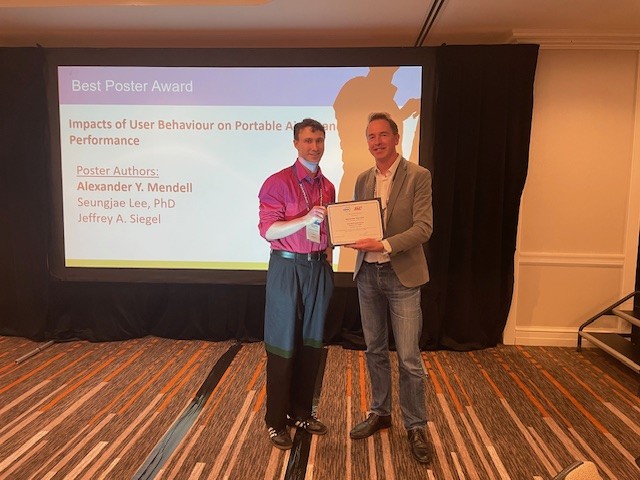
Figure 1: Best poster award, Alexander Y. Mendell (left) & Arnold Janssens (right) at the 45th AIVC - ASHRAE IEQ joint conference